Architecture as a Competitive Advantage
In enterprise software, architecture is destiny. A platform built with the right architectural principles can evolve, scale, and integrate. A platform built as a collection of point solutions stitched together will always be constrained by the gaps between its parts.
RevoraSphere was designed by practitioners who spent years implementing municipal finance systems — and who understood the architectural debt that fragmented legacy platforms accumulate over time. Every decision in the RevoraSphere architecture reflects a specific lesson learned from the limitations of what came before.
This article describes the core architectural layers of the RevoraSphere platform, the design principles behind them, and how they translate to practical operational advantages for Canadian municipalities.
The Five Architectural Layers
RevoraSphere is organized as five distinct but tightly coupled architectural layers. Each layer has a clear responsibility. Each layer communicates with adjacent layers through well-defined interfaces. No layer is optional — they are designed to work together.
Layer 1: Assessment Data Layer
Municipal property taxation begins with assessment data. In Ontario, this is MPAC. In British Columbia, BC Assessment. In Alberta, the Alberta Assessment system. Each provincial authority provides assessment data in different formats, on different schedules, with different update rules for supplementary assessments.
RevoraSphere's assessment data layer is designed to handle all three provincial formats natively, without manual data transformation. Scheduled feeds are ingested automatically. Supplementary assessments are matched to the correct tax account. Assessment appeals are tracked within the same system that manages the underlying tax roll.
This eliminates what is, in most legacy environments, a time-consuming manual process: the periodic import and reconciliation of assessment authority data files.
Layer 2: Core Revenue Engine
The core revenue engine is the heart of RevoraSphere. It implements the business logic for property tax calculation, utility billing, accounts receivable, and cashiering within a single shared data model.
The key architectural decision here is the unified account ledger. Rather than maintaining separate ledger systems for property tax and utilities — which is the legacy approach and the source of most reconciliation complexity — RevoraSphere maintains a single AR subledger where every revenue type is represented as a ledger entry with a revenue type code.
This single decision eliminates:
- Cross-module reconciliation
- Duplicate account records
- Conflicting balance displays between modules
- Year-end reconciliation as a distinct work stream
The revenue engine also implements all rate structure logic: tiered utility rates, seasonal adjustments, penalty and interest calculations, installment billing schedules, and tax rate changes. Rate structures are configured in the platform's administration layer, not hardcoded — so new rate structures can be deployed without software updates.
Layer 3: Integration & API Layer
RevoraSphere does not exist in isolation. Municipal technology environments include GL systems, document management, GIS, building permit software, and other platforms that the revenue system needs to connect with.
The integration layer provides a REST API for all platform functions, pre-built connectors for common GL systems (including Microsoft Dynamics 365 Business Central), and a configurable event-driven notification system that can trigger workflows in external systems when specific events occur in RevoraSphere.
Payment gateway integration supports all major Canadian payment processors, including Moneris, Beanstream/Bambora, and Stripe. PAD (Pre-Authorized Debit) and EFT processing are built into the payment layer with full CPA 005 file generation.
Microsoft 365 Integration
Municipalities already using Microsoft Dynamics 365 Business Central or other Microsoft products benefit from RevoraSphere's native Dynamics 365 integration. Revenue transactions in RevoraSphere can be configured to post automatically to Business Central GL accounts, eliminating manual journal entry and maintaining a complete audit trail in both systems.
Layer 4: Citizen & Staff Portal
The portal layer serves two distinct audiences through a single platform: citizens who need self-service access to their accounts, and municipal staff who manage accounts, process payments, and handle service requests.
The citizen portal is built to WCAG 2.1 AA accessibility standards — a requirement for public-sector digital services under Ontario's Accessibility for Ontarians with Disabilities Act (AODA) and equivalent provincial legislation. It is mobile-responsive, bilingual-ready (English and French), and designed to work on any device without a native app installation.
Citizen-facing features include:
- Unified account view showing all outstanding balances across property tax, utilities, and other revenue types
- Online payment via credit card, debit, or PAD enrollment
- Payment history and statement download
- Exemption application submission with document upload
- Service request tracking
- Usage history and consumption charts for utility accounts
Staff-facing features use the same underlying data layer but present a different interface optimized for high-volume transaction processing, account research, and exception handling.
Layer 5: Analytics & Reporting
Municipal finance leadership needs two categories of reporting: operational reports for day-to-day management and strategic reports for council presentation and annual reporting.
RevoraSphere's analytics layer provides both.
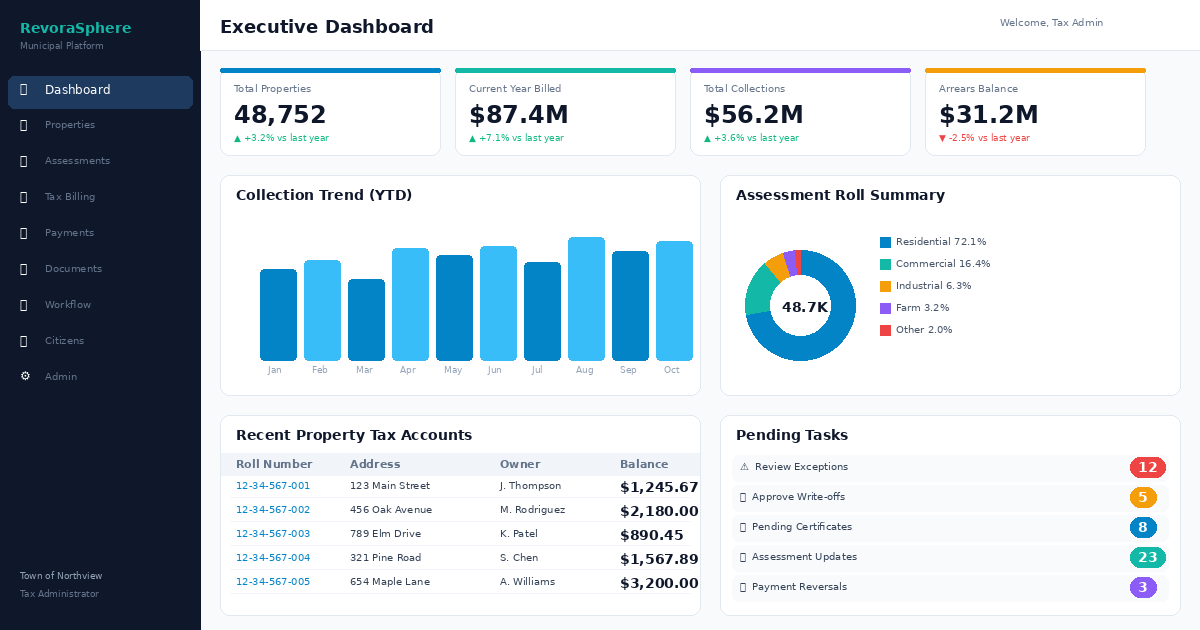
Operational dashboards include AR aging by revenue type, daily collections summary, delinquency tracking by ward or rate class, utility consumption anomalies, and payment channel performance (counter vs online vs PAD).
Strategic reporting includes levy realization analysis, multi-year revenue trend analysis, rate scenario modeling for budget planning, and council-ready PDF exports with the municipality's branding.
Power BI integration allows municipalities already invested in the Microsoft analytics ecosystem to extend RevoraSphere data into their existing Power BI environment. The platform exposes a read-only analytics data feed that Power BI can connect to directly.
Cloud Infrastructure and Security
RevoraSphere runs on Microsoft Azure with Canadian data residency. All data — property assessment records, financial transactions, citizen account information — is stored in Azure regions within Canada. This satisfies PIPEDA data residency requirements and simplifies compliance documentation for municipalities subject to provincial privacy legislation.
The security architecture follows zero-trust principles:
- All API calls require authentication and authorization — there are no implicit trust relationships between services
- Role-based access control (RBAC) governs all staff access, with segregation of duties enforced at the data layer
- Microsoft Entra ID (formerly Azure AD) integration supports single sign-on for staff using their existing municipal Microsoft 365 credentials
- All data in transit is encrypted using TLS 1.3. All data at rest uses AES-256 encryption
- An immutable audit trail records every data change with user identity, timestamp, and previous value
- SOC 2 Type II aligned controls provide a documented security framework for audit purposes
PIPEDA & MFIPPA Compliance
RevoraSphere's data architecture was designed with Canadian privacy legislation in mind from the start. Data residency in Canadian Azure regions, comprehensive audit trails, and purpose-limited data collection align with PIPEDA, MFIPPA (Ontario), FOIPPA (BC), and equivalent provincial legislation. Compliance documentation is available for municipal legal and privacy reviews.
Multi-Tenancy and Isolation
RevoraSphere is deployed as a multi-tenant platform, meaning that multiple municipalities share the same platform infrastructure while maintaining complete data isolation. Each municipality's data is logically isolated at the database layer — a configuration error or security incident affecting one tenant cannot expose another tenant's data.
Multi-tenancy is the architectural basis for the platform's economics. Because infrastructure costs are shared across municipalities, the cost per municipality is significantly lower than a single-tenant deployment while maintaining the same security and availability guarantees.
Update and Maintenance Model
One of the most significant operational advantages of a cloud-native platform over legacy on-premises software is the update model.
In legacy municipal software, even minor updates require testing cycles, change management, and often consultant involvement. Major version upgrades can take months and cost significant amounts in consulting fees. As a result, many municipalities run substantially outdated versions of their revenue software — which means they are missing security patches, regulatory updates, and feature improvements.
RevoraSphere uses a continuous delivery model. Platform updates are deployed by Econix on a regular schedule, tested in staging environments before production release, and applied automatically to all tenants. Municipalities always run the current version. There are no upgrade projects. There are no version compatibility issues.
Regulatory changes — new rate calculation rules, provincial assessment format updates, payment standard changes — are implemented by Econix and deployed to all municipalities without any action required from the municipality.
Conclusion
The RevoraSphere architecture reflects a deliberate set of decisions: unified data over federated integration, cloud-native deployment over hosted legacy, municipal-specific business logic over generic platform customization.
These decisions translate into a platform that is faster to implement, easier to maintain, and more capable than the legacy alternatives it replaces — while costing less over a five-year horizon when total cost of ownership is calculated honestly.
For municipalities considering platform modernization, the architecture conversation is not a technical detail. It is the foundation of every operational outcome the platform will deliver.
See RevoraSphere in Action
Purpose-built for Canadian municipalities. Property tax, utility billing, citizen portal, and analytics — unified.