The Hidden Cost of Fragmented Systems
Ask the finance team at most Canadian municipalities what their biggest operational headache is and the answer comes quickly: reconciliation. Specifically, the painful, time-consuming, error-prone process of reconciling property tax balances, utility billing accounts, and cashiering records that live in three different systems from three different vendors.
This is not a minor inconvenience. It is a structural inefficiency baked into how most Canadian municipalities were forced to build their technology stacks over the past two decades — one system at a time, one procurement cycle at a time, with no overarching platform architecture and no integration standards.
The result is a municipal finance environment where the same account number means different things in three systems, where year-end close is a multi-day reconciliation marathon, and where a citizen who calls about their account requires the service representative to have three browser tabs open simultaneously.
The Fragmentation Tax
Most municipalities cannot calculate their true cost of fragmented revenue systems because the costs are diffuse: staff overtime at year-end, consultant fees for custom reconciliation tools, error correction after billing runs, and the silent cost of citizen complaints that could have been avoided with a unified account view.
What Fragmentation Actually Costs
The costs of disconnected revenue systems fall into four categories.
Direct staff time. Finance staff spend an estimated 15–25% of their total work hours on reconciliation, data entry between systems, and manual processes that exist only because systems cannot communicate. In a municipality with a five-person finance team, that is the equivalent of one full-time employee whose entire job is bridging system gaps.
Vendor maintenance fees. A typical mid-sized municipality paying maintenance on three separate revenue systems — property tax, utility billing, and cashiering — spends $80,000 to $200,000 annually on maintenance fees alone, before counting implementation costs, upgrade projects, or consultant fees.
Error correction. When data does not flow automatically between systems, manual entry errors accumulate. Transposition errors in account numbers, delayed synchronization, and duplicate records create billing errors that require staff time to identify and correct — and erode citizen trust when they result in incorrect bills.
Citizen service quality. Citizens do not understand that their property tax balance lives in one system and their utility account in another. They expect a single coherent account view. When service representatives cannot provide that, call volume rises, escalations increase, and satisfaction falls.
The Case for Platform Consolidation
The argument for consolidating municipal revenue onto a unified platform is straightforward: a single system with a shared data model eliminates the category of problems caused by fragmentation.
What Unification Delivers
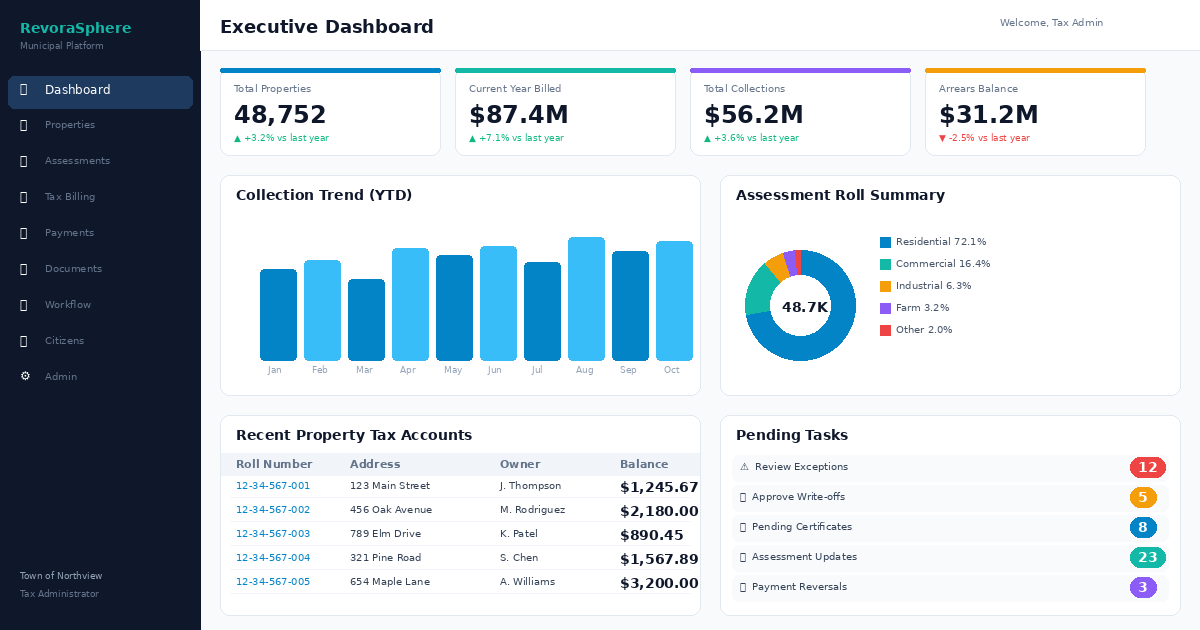
When property tax, utility billing, AR, and cashiering share a single data model, reconciliation becomes a report rather than a project. Year-end close shrinks from days to hours. Citizens get a single account view. And finance leadership gets a real-time dashboard instead of a multi-day data gathering exercise.
A unified platform delivers three structural advantages that fragmented stacks cannot replicate.
One Account, One Truth
In a unified platform, every revenue stream — property tax, utilities, permits, licenses — flows into a single accounts receivable subledger. A payment posted at the counter is immediately reflected on the citizen portal, in AR aging, and in the GL posting queue. There is no reconciliation step because there is no gap to reconcile.
RevoraSphere implements this through a shared AR engine that treats every revenue type as a line in a unified ledger, with revenue type codes that preserve reporting distinctions without creating system separation.
Real-Time Visibility
Municipal CAOs and finance directors should be able to see their collections rate, AR aging, and levy realization in real time — not after a three-day report generation cycle. Unified platforms make this possible because the data pipeline has no hand-offs between systems.
RevoraSphere's analytics layer provides live dashboards that update as transactions post. Collections rate, outstanding AR by aging bucket, utility consumption anomalies, and delinquency trends are available on demand.
Citizen Experience as a Revenue Tool
Municipalities with strong digital citizen self-service consistently achieve higher voluntary payment rates and lower delinquency. When citizens can log in at 10pm on a Sunday, see their combined property tax and utility balance, and set up a payment plan — without calling anyone — they pay.
This is not just a service quality argument. It is a collections argument.
RevoraSphere's citizen portal is built on the same AR engine as the internal cashiering module. A citizen who sets up a PAD arrangement online triggers the same workflow as a PAD arrangement set up by a counter staff member. The data lives in one place.
The Municipal Revenue Technology Landscape
Understanding why unified platforms are now possible requires a brief look at why fragmentation happened in the first place.
Municipal technology procurement in Canada has historically been driven by department-level decisions. The public works department evaluated utility billing software. The treasurer's office evaluated tax roll software. IT evaluated cashiering platforms. Each department selected the best available option for their specific function, often at different times, from different vendors.
This was rational at the project level but irrational at the organizational level. The cumulative result was a technology stack that nobody designed — it emerged from a series of isolated decisions.
The GovTech landscape is now shifting. Cloud-native platforms purpose-built for municipal revenue management make it possible for municipalities to consolidate onto a single system without the prohibitive implementation costs that historically made consolidation impractical.
- Each department selects best-in-class for their function
- No integration architecture or shared data standards
- Reconciliation burden falls on finance team
- Citizen experience depends on worst-performing system
- Vendor upgrades are independent and uncoordinated
- Single platform covers all municipal revenue functions
- Shared data model with one account, one truth
- Reconciliation eliminated — AR is always current
- Citizen experience is consistent across all account types
- Single vendor update cycle — no version coordination
Implementation Considerations
The most common concern municipalities raise about platform consolidation is implementation risk. This is a legitimate concern — replacing core billing infrastructure is not trivial, and the history of large municipal IT projects includes enough cautionary tales to make any CAO cautious.
RevoraSphere addresses this through a phased, module-by-module implementation approach that minimizes the risk of any single implementation phase.
Start with highest-pain module
Most municipalities start with either property tax or utility billing — whichever creates the most reconciliation burden today.
Run parallel for one billing cycle
RevoraSphere runs alongside the legacy system for one full billing cycle. Results are compared transaction by transaction before cutover.
Migrate AR history
Outstanding balances, payment history, and account records are migrated and validated before the legacy system is decommissioned.
Activate citizen portal
Once the core billing module is stable, the citizen portal is activated with the live AR data as its source.
Extend to remaining modules
Subsequent modules are added in phases, each following the same parallel-run validation pattern.
The phased approach means the municipality is never betting the entire revenue operation on a single go-live date. Each phase is independently validated before the next begins.
Conclusion
The fragmentation of Canadian municipal revenue systems is not a technology problem. It is an architecture problem — one that emerged from decades of isolated procurement decisions. The solution is not better integration between fragmented systems. The solution is a unified platform that was designed to handle the full municipal revenue lifecycle from the start.
RevoraSphere is that platform.
Municipalities that consolidate onto a unified revenue management platform consistently achieve lower reconciliation overhead, higher collections rates, better citizen satisfaction, and stronger real-time financial visibility. The business case for consolidation is clear. The technology to support it now exists.
See RevoraSphere in Action
Purpose-built for Canadian municipalities. Property tax, utility billing, citizen portal, and analytics — unified.
Referenced In
- RevoraSphere: Dedicated-Instance Municipal ERP Platform on Microsoft Azure
- What Is RevoraSphere? Canada's Purpose-Built Municipal Revenue Management Platform
- RevoraSphere Architecture: Built for Public-Sector Scale and Canadian Compliance
- From Paper Billing to Digital Revenue: How RevoraSphere Transforms Municipal Finance Operations
- The Future of Canadian GovTech: Why Unified Municipal Platforms Are Replacing Legacy Software